
How Greensville Property Records Connect
No single office holds a parcel's whole story in Greensville County. The split is easy to learn. The Commissioner of the Revenue keeps the assessment cards. The Treasurer tracks tax tickets and payments, the Circuit Court Clerk records deeds and liens, and WebGIS places tax parcels on a map. A street address works well as a first clue. After that, carry the parcel ID and legal description from one system into the next. The picture is strongest when the card, the tax account, the map, and the recorded instrument all point to the same land.
Each tool has its job. Read the assessment card for the parcel's public summary. Ask the Treasurer when the question is what was billed or paid. Use the land-record index to confirm a conveyance or find another instrument. WebGIS shows location and nearby parcels. Its outline, though, is not a survey. A name on a tax card is an assessment entry rather than a title opinion, and a recorded deed can be newer than the latest assessment update.
- Search the county property-card service by address, owner name, or parcel number.
- Copy the parcel number, situs line, mailing line, and any legal-description reference shown.
- Use the same parcel ID in Treasurer e-services for tax-ticket and payment history.
- Search Virginia SRA/COVERS by the relevant grantor or grantee to find recorded instruments.
- Use WebGIS for map context, then ask the clerk or Commissioner for an official copy or clarification.
Greensville Property Records Offices
Each custodian serves a different question. Start with the record you actually need. Greensville Circuit Court sits in Virginia's 6th Judicial Circuit, and its clerk records deeds, deeds of trust, plats, liens, probate papers, and court files. The Commissioner of the Revenue runs the property-card search. The Treasurer handles real-estate tax inquiry and payment history. WebGIS serves as the county's map reference. Emporia is the county seat, yet it is an independent city with separate land records, a distinction that matters even when a mailing address says Emporia.
Greensville Circuit Court Clerk
337 South Main Street
Emporia, VA 23847-0631
(434) 348-4215
Open 8 a.m. to 4 p.m.
Greensville Property Card Search Fields
The Commissioner's page names three ways into the card system: Owner Name, Parcel Number, and Address. That makes a useful entry point. A known address can lead to a stable parcel ID for Greensville property records, and that ID then works in the tax and map systems. The public page lists what a card may hold. Summary information, improvements, sketches, and photos appear when available. The detailed card sits behind an acknowledgement screen. Its exact result fields and required search rules are described on that screen rather than the public page.
| Field | Type | Required | Verified use |
|---|---|---|---|
| Owner Name | Name text | Not stated | Search the name as it appears on the assessment roll. |
| Parcel Number | Text | Not stated | Copy the parcel key exactly once a result is found. |
| Address | Text | Not stated | Start with the situs address; rural formatting is unverified. |
The official property-card landing screen lists those same three inputs. The acknowledgement page guards the detailed display. Plan to accept its terms on the county site itself. Treat land value, improvement value, exemptions, last-sale data, and legal-description fields as items to confirm. Confirm them on the live result. The county publishes them when available.
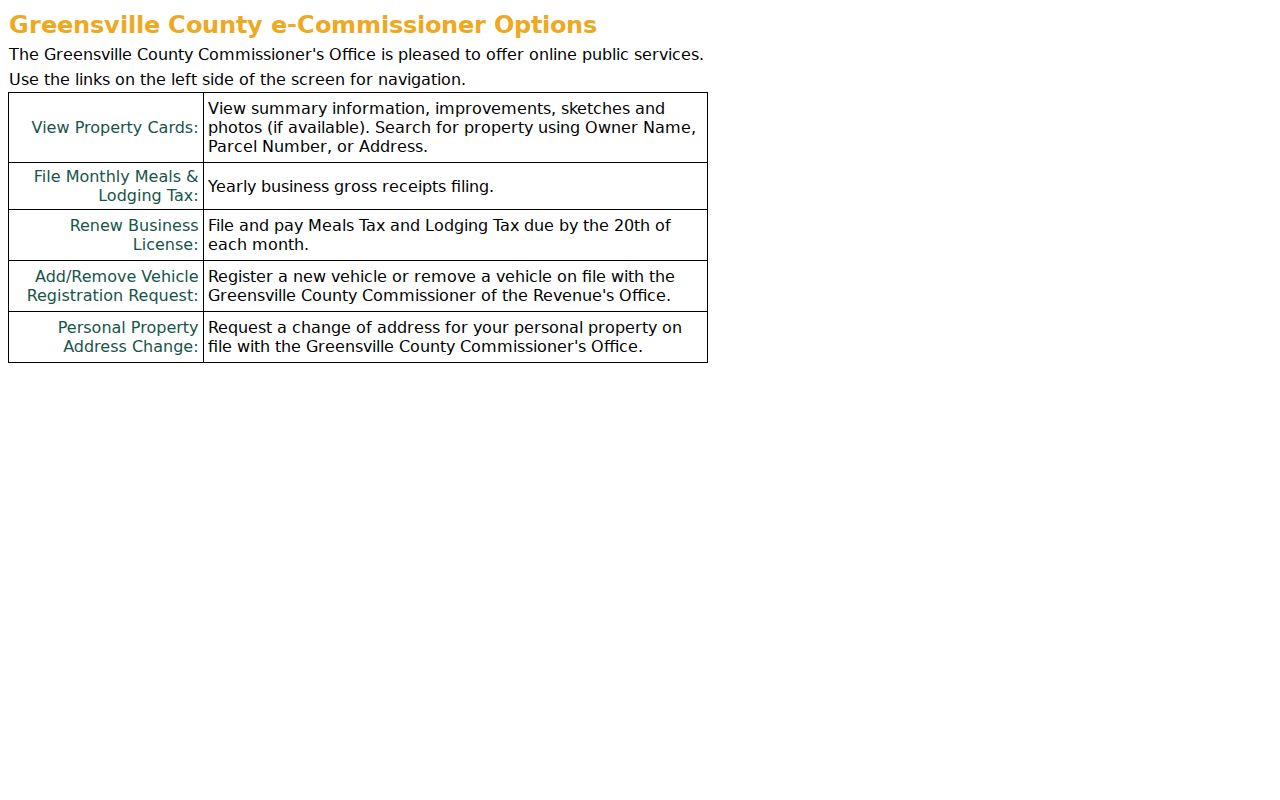
This page marks the public entry point. Save the returned parcel ID, then confirm ownership with a deed or clerk copy.
Greensville Tax Ticket and Payments
The Treasurer's site sits apart from the Commissioner's cards. Real-estate tax tickets open through three lookups. Name, Department/Bill Number, or Parcel Number each works. The same site offers payment history and a yearly taxes-paid inquiry. They show what was billed or recorded as paid. They establish nothing else. A bill amount is not a title, a market value, or a legal boundary.
One caution comes from the Treasurer's own notice. An online balance may miss a payment or adjustment still in transit, and the data carries no warranty. Keep the lookup date and tax year with any figure you save. A sale or refinance may need a current payoff figure. Ask the Treasurer what official statement covers that. The county posts no fee schedule or complete history range on the e-services screen.
The Treasurer e-services landing screen shows the real-estate inquiry and payment-history paths. It also lists other tax and fee services. Those are not parcel real-estate taxes, so use the bill or parcel key as a cross-check rather than a deed reference.
Greensville Deed Index Access
All Greensville land instruments pass through the Circuit Court Clerk, who indexes them online through Virginia Secure Remote Access, known as SRA or COVERS. The statewide service states that public land records kept by circuit clerks fall under Va. Code §17.1-294 and following. Index-only access may be free when the clerk enables it. Images stay under local control. The clerk can require an authorized subscription, a signed agreement, and a fee before releasing them. Greensville's online starting year and exact dropdown choices go unstated in the public description.
Searching a party works both directions. Enter a grantor when that party conveyed an interest. Enter a grantee when the party received one. Treat an index hit as a pointer, nothing more. Open the instrument itself to see whether it is a deed, a deed of trust, a release, an easement, a plat, or some other filing. A release signals a payoff, not a new buyer. A deed of trust secures a loan rather than proving a sale. For certified copies and image access, confirm the details with the clerk.
The Virginia SRA entry page separates index searching from image viewing. The companion official SRA explanation describes the system's role. The local court page names the clerk who can answer a Greensville records question. The entry page posts no sample result. When the index does not expose an image, ask the clerk for a copy directly.
Greensville Historic Land Records
The Library of Virginia finding aid offers the deepest time depth for Greensville property records. Deed Book No. 1 opens in 1781. The catalog lists a general deed index covering 1781 through 1878. Separate grantor and grantee index runs stretch from 1781 to 1975. A grantee index then continues from 1975 through 1983. None of that matches the modern SRA cutoff, which the public sources leave unstated. When tracing old ownership, record the reel, book, page, party role, and legal description. A clerk or archive worker can pull the same item again from those details.
The finding aid goes beyond deeds. It lists indexes to plats, judgment-lien docket books, fiduciary material, and processioners' returns. A processioner's return documents historic boundary work. It may name adjoining owners, roads, watercourses, or old tract calls. Those details can clarify a modern deed. Treat it as context, never as a current survey. A gap in an index deserves a question before a conclusion. Ask whether a book was renumbered, unfilmed, or filed in another series. It may simply sit outside the listed run. Never assume a courthouse fire or a missing volume from a catalog gap alone.
The Library of Virginia Greensville finding aid lists the early books and reels. It is the right starting point for a historical chain of title. The clerk remains the local source for current recording and certified copies. The catalog itself is a finding aid, not an online deed image. When you chase a prior owner, request the cited reel or book by its numbers.
Greensville and Emporia Jurisdiction
Emporia serves as the county seat. But it is an independent city with its own land records. A mailing line reading Emporia proves nothing. It cannot show which side of the line the parcel sits on. Jarratt adds a second wrinkle. Its 1938 charter places the incorporated town in both Greensville and Sussex Counties. A Jarratt postal address cannot pick your circuit clerk. Place the parcel on the county map first. Then route the assessment, the tax ticket, and the deed request to the locality holding the land.
County and city names can look nearly identical in an online result. Yet they point to distinct record books. One wrong jurisdiction turns a correct name search into an empty one. For land near a line, compare the tax-map parcel, the deed legal description, and the relevant town or county map. If those sources disagree, call the local clerk. The home search starts with the county card only when the land sits on the Greensville side.
Greensville Parcel Map Context
Greensville WebGIS serves as a parcel-reference map. The county landing page notes that users may need county credentials. Those credentials gate the secure viewer. It also warns that mapped data is not guaranteed accurate. It is no substitute for a land survey. A posted notice dates the map data to August 2026. A county agenda attachment shows parcel lines alongside roads, water features, scale, and a coordinate readout. It cannot confirm the viewer's current layer names or tools.
Use the map to orient a property search and collect a possible parcel number. Turn to the deed and recorded plat for the written land description. A shared line on a tax map is a lead, not a final boundary call. For an exact line location, a licensed surveyor is the proper source. Near Emporia or Jarratt, use the map for locality context. Then confirm jurisdiction with the relevant clerk.
The Greensville WebGIS secure-viewer link sits behind the county's public landing page. Its published disclaimer should travel with any screenshot or exported view. The viewer entry proves no surveyed line and no verified adjacent-parcel tool.
Greensville Probate Transfers
A deed chain that suddenly stops under one person's name often has a simple explanation. That owner died. Probate records held by the Greensville Circuit Court Clerk can fill the gap. The catalog reaches back generations. It covers fiduciary accounts from 1877 through 1911 and a settlement book from 1911 to 1927. Guardian books, bond books, and older court orders are there too. Begin with the decedent's name. From there, look for an executor or administrator, and a qualification date. Also check for any court order permitting a sale or distribution. Then carry the search into the land index. Look there for a fiduciary, executor's, administrator's, or commissioner's deed, or a deed of distribution.
Vital records help but convey nothing. Virginia's Office of Vital Records issues certified death, marriage, birth, and divorce certificates statewide. Death records become public after 25 years. Earlier ones require a qualifying requester with ID and the stated $15 certificate fee. Eligibility is explained in the VDH FAQ. The certificate proves the event. The probate file and the deed that follows show how the property interest actually moved.
Greensville Liens and Releases
The land index holds more than sale deeds. A thorough parcel search should reach deeds of trust, assignments, certificates of satisfaction, easements, covenants, corrective instruments, judgment liens, mechanics' liens, and plats, since these instruments define a property's recorded encumbrances. Virginia titles often use a deed of trust instead of a mortgage label. Read the instrument itself. Then read any later release. A lender's name alone does not tell whether the debt remains open.
The Library of Virginia lists Greensville judgment-lien dockets from 1875 into 1916. Those reels help with older work. Early deeds sometimes cite a lien or court order. SCC UCC filings can matter for fixtures or business interests. Still, a business filing does not prove ownership of the parcel; current liens, tax balances, and title questions belong with their separate custodians.
Greensville Tax Sale Requests
Greensville publishes no official foreclosure calendar, delinquent-tax list, or sheriff-sale portal. That gap does not mean no sale or case exists. Ask the Treasurer about a delinquent ticket. Ask the Circuit Clerk about a lis pendens, foreclosure file, order of sale, sale confirmation, or recorded trustee's deed. A sale notice is not a completed conveyance.
Give the clerk the parcel number first. Add the owner or entity name, legal description, and date range. A rural street address may not appear in a court caption. For a tax-sale inquiry, request the notice, sale advertisement, purchaser information, confirmation order, and any deed. For foreclosure, ask for the pleadings and sale report. Use SRA to find recorded land instruments, then request copies through the clerk.
Virginia FOIA for Greensville Records
The Virginia Freedom of Information Act opens a practical route when a local property record is not posted online. Name the office, parcel or address, record type, date range, and preferred copy format. FOIA does not require an office to create a new map, spreadsheet, title opinion, or analysis. It covers existing records subject to exemptions. The first response period runs five working days. A public body may charge actual costs for searching, duplication, and delivery. Any denial must cite the legal basis for withholding.
Request rules appear in the Virginia FOIA statute. The 2026 FOIA access guide summarizes them too. The guide restates the five-day response rule and its cost standard. The Circuit Clerk can also advise whether a deed image, certified copy, or in-person inspection follows a different process. Ask the custodian for its current copy process.
Greensville Property Record Types
The record set matters. A different custodian answers each question. Greensville property records can identify a tax parcel, show billed amounts, locate instruments, and describe mapped geography. No single result replaces a title review, a survey, or an appraisal.
| Record | What it documents | Custodian | Access |
|---|---|---|---|
| Deed and deed of trust | Recorded conveyance or security interest | Greensville Circuit Court Clerk | SRA index; image or copy via clerk |
| Property card | Assessment summary, improvements, sketches, photos if available | Commissioner of the Revenue | County property-card e-services |
| Tax ticket | Billed amount, status, payment history | Greensville Treasurer | E-services, phone or office inquiry |
| Plat and parcel map | Recorded lot description and map reference | Clerk, LVA, WebGIS | SRA, finding aid, secure viewer |
| Permit or zoning record | Land-use action, not title | Jarratt or county office, by jurisdiction | Ask custodian; no searchable Jarratt portal exposed |
Limits of Greensville Property Records
A Greensville property card tells you a lot. It is not a title report. A tax balance is not a payoff letter, and a parcel polygon on a GIS map is not a legal boundary. A deed index can point to an instrument whose image the clerk controls. Every record has a role and a limit. For a purchase, an estate, or a boundary dispute, confirm the record with its custodian and bring in a professional for the title, survey, appraisal, or legal opinion you need.
Lawful use. Use Greensville records for property research, due diligence, tax questions, and civic review. Do not use an owner's public address to stalk, threaten, or harass anyone. Public availability does not make harmful use lawful.