
Find Who Owns a Greensville Property
Who owns a Greensville property? The honest answer is a record trail, not a single name match. Start with the assessment owner shown for the parcel. Then confirm the newest conveyance in the Circuit Court Clerk's land records. The card points to an owner and a parcel. The deed explains which party received the recorded interest. If the two sources disagree, note their dates. Ask whether an assessment update is pending. A map can help you locate the land, but it never decides ownership.
- Use the address or parcel to locate the assessment card for the land in question.
- Copy the exact parcel ID and the name displayed as the assessment owner.
- Search that party as grantee in Virginia SRA/COVERS and identify the latest deed of conveyance.
- Read the deed's legal description and compare it with the parcel card or map.
- If the name is an estate or business, check the related probate or entity record without treating it as a deed substitute.
This route finds a recorded owner trail, nothing more. It is not a title opinion, and it cannot prove that no other claim, lien, or unrecorded interest exists.
Greensville Property Owner Sources
Greensville spreads its ownership clues among several agencies. The Commissioner card is an assessment record. SRA serves as the online index for recorded land instruments. The Treasurer holds the tax account, not the grantee. WebGIS helps identify where the parcel sits. Use these sources in order and keep their dates side by side, so an old assessment line does not appear to override a newer deed in the property records.
| Source | What it can show | How to read it |
|---|---|---|
| Commissioner property card | Owner-name search, parcel, and available summary categories | Assessment owner; detailed field label not verified |
| Virginia SRA/COVERS | Grantor/grantee index for land records | Find and read the newest deed of conveyance |
| Treasurer e-services | Tax bill and payment history | Account cross-check, not title |
| WebGIS | Parcel map context | Locate land; not a survey or owner certification |
Start with a parcel match whenever you can. A name-only search may return a same-name taxpayer. It may pull a trust, or a business account tied to a different address entirely. On the card, note the parcel and the exact owner label. In SRA, search the grantee name and confirm the legal description. On the tax screen, use the parcel number. That makes sure the bill belongs to that land. Record which system supplied each fact and when you searched it. That habit gives you a traceable answer. It avoids turning one database label into a title conclusion.
Greensville Assessment Owner Field
The county property-card landing page offers a search by Owner Name. The service may show summary information, improvements, sketches, and photos when available. The detailed result adds an owner label. It also shows mailing address, situs, last-sale date, value history, and exemption fields. The card acknowledgement screen comes before the full record. If the page shows several results, compare parcel and location before picking one. The exact partial-name rule and the number of results returned are not published. Describe the displayed name as the assessment owner only after viewing the card itself. The landing page alone does not prove current title.
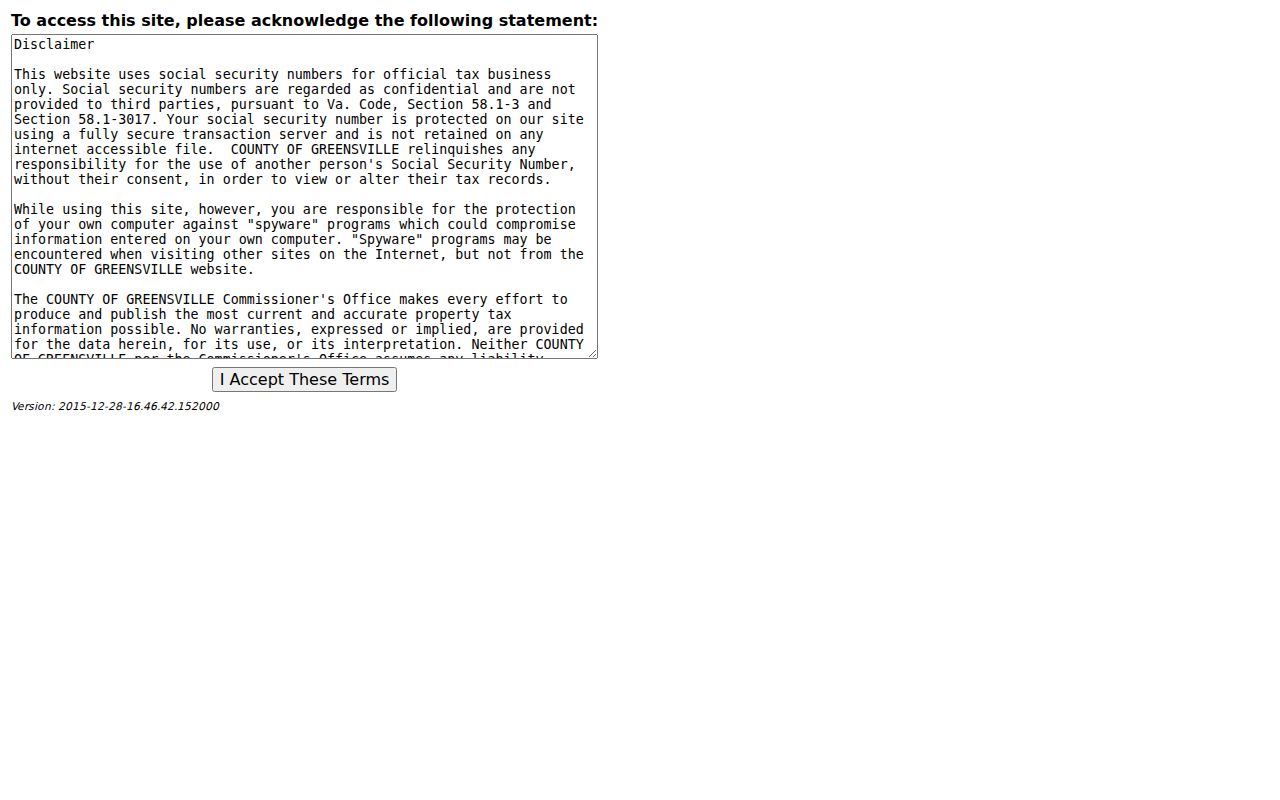
The acknowledgement screen marks the access step, not a displayed owner or sample parcel. A live card must be viewed before any field counts as confirmed.
Confirm a Greensville Owner by Deed
The newest recorded deed is the next check after the assessment roll. Search the displayed owner as grantee. Then inspect the instrument type, recording date, grantor, and legal description. The result should match the parcel card. A deed of trust, release, easement, or plat is not automatically a sale deed. If the public index gives only a pointer, contact the Circuit Court Clerk. Ask about image access or a copy.
SRA may provide free index-only access when the local clerk enables it. Images can require clerk-authorized access, a signed agreement, and a fee. The official source states no online cutoff year or copy prices for Greensville deed records. The current chain and historical indexes appear in the deed and former-owner resources. A single owner question needs only the newest conveyance. Match it to the parcel with enough land-description detail.
Greensville Situs and Mailing Names
The situs address identifies where the land sits. The mailing address identifies where a tax notice goes. They may differ because an owner uses a post office box, an agent, a business, or a home elsewhere. That difference does not by itself suggest a problem. Record both fields separately when the live card displays them, then compare the deed's legal description and the map location rather than treating a mailing line as the property's location.
Jurisdiction must be resolved before any owner search. Emporia is an independent city with separate land records. Jarratt is an incorporated town that crosses Greensville and Sussex. A postal name may therefore hide the clerk who actually recorded the deed. For property near a boundary, ask the clerk or county office to verify the locality before trusting a blank search result in the property records.
Greensville Entity and Estate Owners
Deeds and assessment cards in Greensville often list more than a single person. The named party may be an LLC, a trust, an estate, or several co-owners. Executors, trustees, administrators, and commissioners appear too. Search the exact legal name, then try common variants. The Virginia SCC Clerk's Information System helps pin down an entity filing or its registered agent, but a corporate record alone never proves the business holds a parcel. Only the recorded deed settles that question. For estates, the Circuit Court Clerk's probate file shows who had authority and how the property changed hands.
Read each record for its role. A beneficiary in a will is not always the grantee on the deed. A trustee can convey land for a trust without holding any beneficial interest. A registered agent just receives legal notices for an entity. Keep the roles separate. When the assessment name and the deed party disagree, compare the recording dates and ask the custodian which record was updated more recently.
Greensville Tax and Map Cross-Checks
Cross-checks sharpen any Greensville owner search. The Treasurer page offers tax lookup by name, Department/Bill Number, or parcel number. It also provides payment history and an annual taxes-paid inquiry. That confirms which account belongs to a parcel, but it proves nothing about title. WebGIS displays the mapped parcel and nearby roads. Its disclaimer notes the map is not a survey. Treat both as supporting tools after a deed search, never as ownership authorities.
Jurisdiction matters just as much. A Jarratt location may sit under the town's own parcel system rather than Greensville's. An Emporia address could lie inside the independent city instead of the county. Match the parcel to the right jurisdiction before trusting any result. A postal address alone cannot settle that question.
Greensville Owner Record Gaps
Some gaps simply exist. The official pages do not say how quickly an assessment card updates after a closing, and they omit the current SRA index cutoff, the exact online result fields, and local deed-copy fees. That matters when a newly purchased parcel still shows the prior owner of record. Compare the recording date to the card, note your search date, and ask the Commissioner how updates are handled. No standard lag should be assumed for Greensville.
When a record is not online, go to the right custodian. The Commissioner holds the assessment record. The Circuit Court Clerk keeps recorded instruments. The Treasurer manages the tax account. A specific Virginia FOIA request can seek an existing record if you name the parcel, the record type, and a date range. FOIA cannot force an office to build a title search for you.
Limits of a Greensville Owner Lookup
Any Greensville owner lookup returns a clue, not a verdict. An assessment card may lag behind a recent transfer. The grantee may turn out to be a business or a fiduciary. A GIS shape can drift from a surveyed boundary. A tax ticket may look current while the deed image stays gated. Put the records side by side. Then bring any conflict to the custodian or a title professional. Public property records support lawful research, due diligence, estate matters, and civic work.
The current-owner record route centers on the assessment display and its timing. The recorded deed remains the true proof of conveyance.
Not a title search. An owner name on a card is not a guarantee of title. Do not use a public address or owner record to threaten, stalk, or harass any person.