
Tracing Greensville Former Property Owners
Every Greensville deed names two parties. Read backward from the most recent conveyance. The chain of former property owners builds itself one deed at a time. The person who sold the parcel shows up as a buyer in an earlier book. Confirm the land at each step. Older deeds rarely carry a modern street address. A tract may have been split or combined over the years. Trust the legal description. It is the thread that holds the whole Greensville chain together.
| Chain stage | Record to capture | Next search | Source route |
|---|---|---|---|
| Current conveyance | Recording date, grantor, grantee, book/page, legal description | Search grantor as grantee | SRA/COVERS or clerk copy |
| Earlier transfer | Prior deed reference and tract calls | Compare acreage and adjoining names | Land-record index and image |
| Historic index era | Alphabet segment, reel, deed book, page | Read the cited deed, not only the index | Library of Virginia microfilm |
| Estate or court branch | Fiduciary name, order, and deed reference | Check probate or court file | Circuit Clerk and archive |
A name alone proves nothing. Before any deed joins the chain, its land description must describe the very same Greensville tract.
Greensville Grantor-Grantee Trail
Every deed has two sides. The grantor conveyed or released an interest, and the grantee received it. Begin with the current owner's deed. Copy the instrument type, the book and page or instrument number, the recording date, and the land description. Search that grantor as a grantee next. Repeat the cycle until you reach the needed era or hit a gap that calls for a different record series.
Deed types matter. A warranty or quitclaim deed marks a transfer. A deed of trust only secures a debt, and a release or satisfaction closes that interest. An easement changes a use right, and a plat supplies lot context, so no instrument should be labeled a sale unread. Note spelling variants and fiduciary roles too.
- Chain of title
- A sequence of recorded transfers and other interests tied to a tract.
- Grantor
- The party conveying or releasing the stated interest.
- Grantee
- The party receiving the stated interest.
- Reverse index
- A practical search backward from grantee to the prior grantor.
- Quitclaim deed
- A conveyance of whatever interest the grantor holds, without the same promises as a warranty deed.
How Far Greensville Owners Go Back
The Library of Virginia finding aid opens Greensville deed research with Deed Book No. 1, covering 1781–1792. A general deed index spans 1781–1878. Grantor and grantee indexes cover 1781–1975. That span is the historical depth itself. The grantee side runs through 1983, but the online SRA cutover is another matter, since the official SRA page leaves its Greensville start year unstated.
Record everything. For older entries, capture the reel, the index segment, the deed book, the page, and each party's role. An index line may point to a volume without showing the instrument, so read the deed itself and compare its land calls. If the sequence skips a book number or an index gives no date, ask the Clerk or LVA whether the item was renumbered, unfilmed, held elsewhere, or left out of the catalog.
Two tools serve different eras. The Greensville microfilm catalog covers the deep history, while the SRA index serves the newer period. Current recording and copies stay with the local clerk.
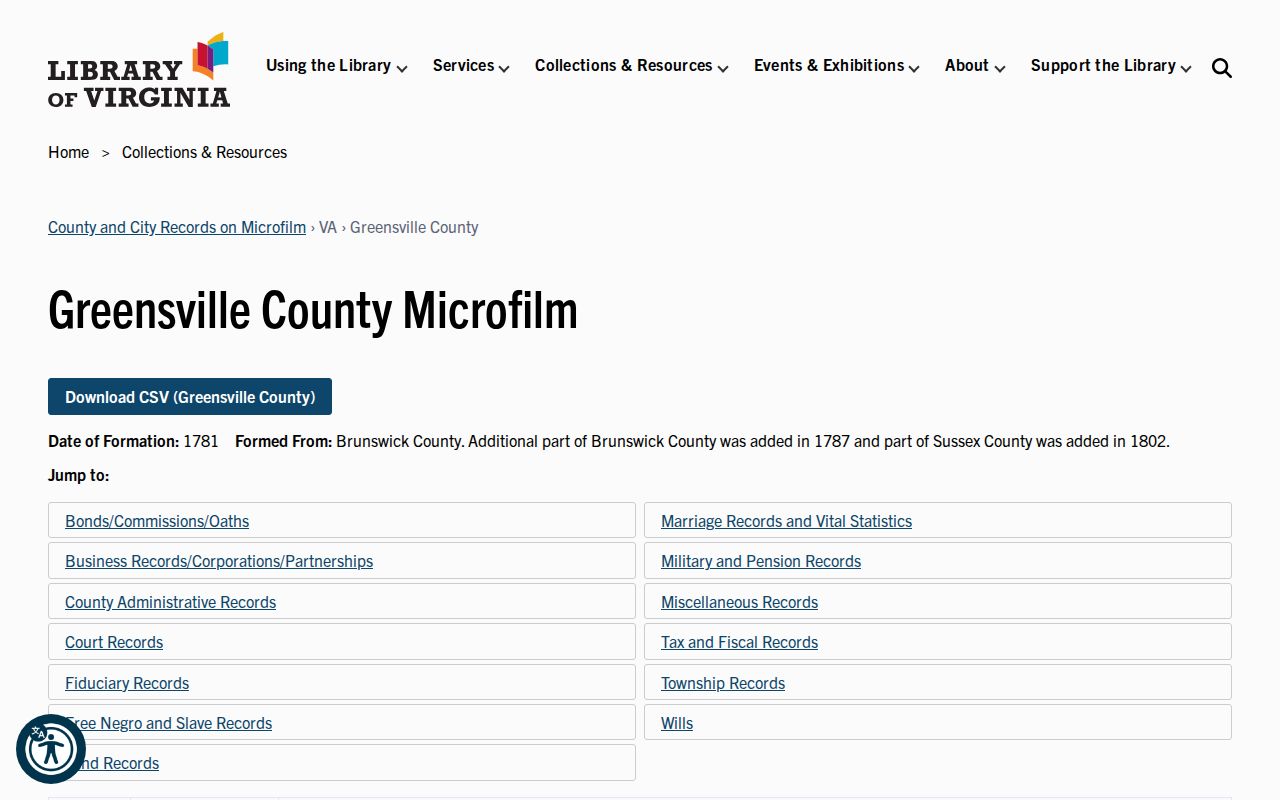
The view shows catalog listings, not deed text.
Greensville Deed Books by Era
The catalog breaks Greensville's deed books into eras. Books 1–8 carry 1781–1848, one more book runs 1848–1862, Book 10 covers 1863–1874, and Books 12–22 span 1878–1902. Reel 6 holds the general index for 1781–1878. Reels 54–57 contain grantee alphabet segments through 1975 plus the 1975–1983 grantee run. Grantor segments through 1975 sit on Reels 58–62. Reel 71 indexes plats, with no dates given. These reel numbers are unusually helpful here.
An online index may not reach the years a Greensville house history needs, but the microfilm does. Silence on Book 11 proves no lost book. Older deeds often describe a tract as formerly owned by a neighbor, or locate it by a creek or an old road. Keep the tract description in a notebook, and follow adjoining names when the party index stops matching the modern address.
Greensville Probate Branches
Not every chain runs through a sale. Some Greensville parcels moved through an estate instead, and probate records pick up the trail. The Greensville Circuit Court Clerk handles those files. The LVA catalog lists guardian books, fiduciary accounts from 1877–1911, a settlement book for 1911–1927, fiduciary lists, bond books, and older court order volumes. Search the decedent first. Then try the executor, administrator, or commissioner. Look for an order authorizing a sale or distribution, followed by a later fiduciary deed.
A will or death certificate explains the name change. Neither one proves the land actually transferred. Virginia VDH opens death, marriage, and divorce records to the public after 25 years, though earlier certified copies require an eligible requester, ID, and the stated fee. For the land itself, use the circuit clerk's order and the recorded conveyance.
Greensville Historic Boundary Clues
The LVA catalog lists processioners' returns from 1796–1820, 1820–1832, and 1848–1857. An entry may name a neighbor or preserve an old boundary route. A deed chain can shift from a road name to a creek, monument, or adjoining tract. That kind of entry helps here. Treat a return as context for a parcel history, never as a modern survey. Weigh it against a deed, a recorded plat, and later transfers before concluding anything.
Older descriptions lean on acreage, vanished roads, streams, and neighbor names. A street address was rarely part of them. Search grantor and grantee variants, and record the index location along with the deed citation. The modern parcel card may show a different parcel number. Keep both numbers in that case. Ask the Commissioner about a cross-reference. The county publishes no APN-format guide.
Greensville Lien and Fiduciary Records
A former owner's timeline often needs more than deeds. Judgment liens, deeds of trust, releases, and satisfaction records all bear on the property. They all bear on who held it. The historic catalog lists Greensville judgment-lien dockets running from 1875 into 1916. For each entry, note the debtor. Note the creditor, the docket book and page, the date, and any later satisfaction. A lien entry is a clue to an encumbrance. It is not proof that a later conveyance failed. Read the release or court order that closes the branch.
Fiduciary books can explain a guardian or estate transfer. A plat index can explain a subdivision lot. A court order may even authorize a commissioner to convey land. These sources add context when a clean person-to-person name chain breaks in Greensville property records. A complete chain comes from reading instruments, not from collecting index hits.
Greensville Jarratt Chain Branch
A Jarratt address may split between a Greensville chain and a Sussex chain. The town charter shows incorporation on June 20, 1938. Its land lies in both counties. Emporia is a separate independent city, not part of Greensville's land-record system. Resolve the parcel's legal jurisdiction before extending a former-owner search. The right name in the wrong county index produces a false dead end.
Check the current parcel location first. Check the deed description too. Then ask the relevant circuit clerk for historic book references. The charter also points to an original boundary plat kept in a clerk's map book. The county records show no later annexation. A postal town or ZIP alone is never enough to choose a grantor-grantee series.
Greensville Former Owner Requests
When the public index stops or the image sits behind a gate, work through the custodian chain. Ask the Greensville Circuit Court Clerk about an office terminal. Also ask about image access or a deed copy. Use the Library of Virginia finding aid for the cited microfilm reel. Request county records under Virginia FOIA when the item belongs to a public body. Include the parties, instrument type, recording date, book and page, parcel number, and legal description. Say whether a certified copy is needed.
Fees and image terms change, so ask before ordering. Keep the chain status clear at each step. Note whether the index was found, the deed was read, or a certified copy was obtained. An index hit is not a deed reading. A deed reading is not a current title opinion. For a single instrument, the deed records page covers the copy route in detail.